.svg)

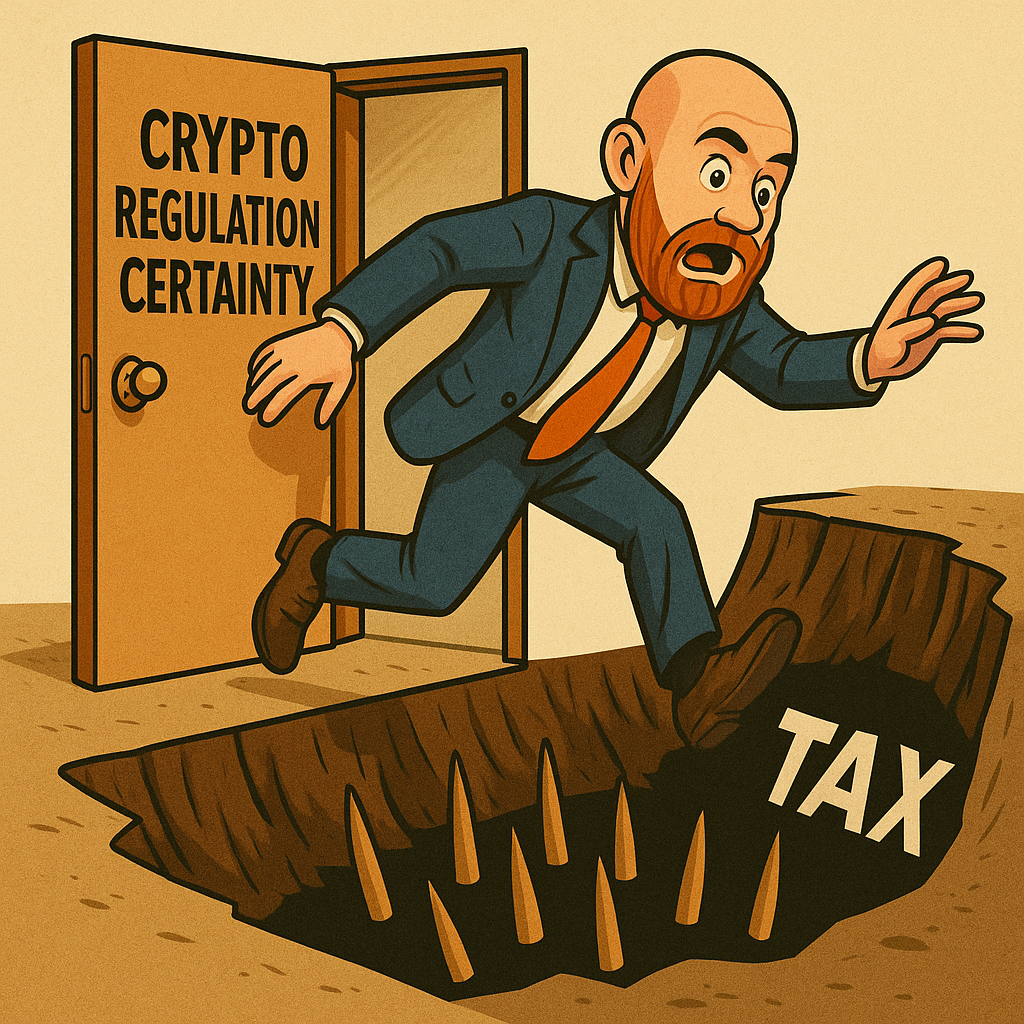
On 19 August 2026 the ATO released draft Taxation Determination TD 2026/D2. The Commissioner's view is that wrapping a crypto asset triggers a CGT event, and unwrapping it triggers another. Wrap ETH into WETH to use a DeFi protocol, then later unwrap it, and on the Commissioner's view you have had two CGT events on a single one-to-one, reversible position.
This is more significant than the web guidance the ATO has relied on for crypto to date. Once finalised, a Taxation Determination is a public ruling that binds the Commissioner. The companion airdrop draft, TR 2026/D1, was released the same day; this article covers wrapping only.
What wrapping is
Wrapping locks one crypto asset in a smart contract and mints a new token that represents it, usually one-to-one. The common example is wrapping Ether (ETH) into Wrapped Ether (WETH) so it works as a standard ERC-20 token. You can unwrap at any time to get ETH back. Wrapped tokens are used throughout decentralised finance, and WETH sits behind a large share of on-chain activity.
Wrapping is not bridging (moving an asset to another blockchain), and it is not depositing with a custodian. The draft is narrow on subject matter.
The analytical framework
The CGT analysis, as always, follows three key steps.
Step 1: Does a CGT event happen?
The Commissioner says yes. The event is CGT event C2 under section 104-25, which happens when ownership of an intangible CGT asset ends by, among other things, the asset being abandoned, surrendered or forfeited (section 104-25(1)(d)).
When you send ETH to the wrapping contract, the Commissioner treats your ownership of that ETH as ending by abandonment, with surrender as a fallback. The WETH you receive is a new and separate CGT asset, not the same asset in another form. Unwrapping is a second C2 event: the WETH is burnt and ceases to exist, and the ETH you receive back is again treated as a new asset.
The reasoning turns on each recorded balance being a distinct digital object, and so a distinct CGT asset, even though WETH is pegged to ETH and tracks its value.
The Commissioner has said this is not CGT event A1, as there is no counterparty to dispose of the asset to. This is not free from doubt, further comments below.
Step 2: Cost base and consequences
On wrapping, you work out a capital gain or loss on the ETH you gave up: the market value of the WETH received, less the cost base of the ETH. The WETH takes a cost base equal to the market value of the ETH at the time of wrapping.
Unwrapping runs the same way in reverse. Because WETH tracks ETH, the gain or loss on any single wrap or unwrap is often small, but each event still has to be identified, valued and recorded, and any accrued gain on the underlying can crystallise when you wrap.
Step 3: The cost base argument
The Commissioner's strongest point is about cost base, as if wrapping were not a disposal, the WETH could take a nil cost base.
The market value substitution rule in section 112-20 only lifts the cost base to market value where you acquire the asset from another entity, and a smart contract is not an entity, so on that view the rule does not apply. Treating wrapping as tax-free would then set up a larger gain when the WETH is later sold or burnt. On that basis the Commissioner presents CGT event C2 as the outcome that favours the taxpayer.
The plain challenge to this view is that a smart contract has a wallet address, and wallet addresses have private keys, and the private key holder or the maintainer of the smart contract is the counterparty to wrapping transactions. Whether that party has burnt the keys, as is usual, is something for inquiry not a general statement as the determination covers. There are complex follow on effects, not worth labouring in this article.
The Commissioner does consider the alternate view at paragraph 50 but concludes that there is no counterparty. This is not true of many smart contracts legally or economically. For instance, where protocols are hacked, often the operators of the protocol compensate users where possible, implying a relationship between the user and the protocol operators. All this analysis, is not present in the draft determination.
Abandonment is a stretch
The determination depends on sending ETH to a wrapping contract being an abandonment of that ETH.
Abandonment ordinarily means discarding property with the intention of giving up any future claim to it, which is the meaning the draft adopts. Wrapping does not fit that, because the whole purpose is to get the equivalent amount back on demand. To get there the draft relies on Re Jigrose Pty Ltd [1994] 1 Qd R 382 and accepts, in its footnotes, that the asset is still abandoned even where you expect an equivalent quantity of almost identical tokens back - which should be an obvious error as if I abondon something I do not expect something back. Further, many wrapping contracts allow for unwrapping, which is a clear challenge for the abandonment characterisation.
The TD also runs surrender and release as fallbacks, while conceding that surrender usually means handing the asset to another legal entity, which does not happen with an autonomous contract. Relying on three overlapping characterisations to reach one event shows how uncomfortable the fit is. There is room for a reasonably arguable position here.
The key foundation is still before the High Court
The determination rests on a crypto asset being property, with holding rights that can be abandoned. For that the Commissioner relies on the Full Court of the Supreme Court of Tasmania in Poulton v Conrad [2025] TASFC 7.
That decision is on appeal to the High Court. The appeal was heard on 13 August 2026 before a seven-member bench, and judgment was reserved. The ATO published this draft six days later, while the judgment sits reserved. This is not good administration!
The Commissioner intervened in that appeal and argued that a bitcoin holding is property in line with the previous view in TD 2014/26. He argued that property is control over access to a thing to the exclusion of others, relying on the High Court in Yanner v Eaton and on Professor Gray's work, rather than something that needs prior legal endorsement before it counts as property. The relevant "thing", on that argument, is the token balance recorded on the ledger at a unique address, controlled through the private key, with the private key giving as much control as the nature of the asset allows. He relied on decisions across the common law world treating crypto holdings as property, including Ruscoe v Cryptopia in New Zealand and Re Blockchain Tech in Victoria, and conveniently rejected the argument that a crypto asset is not property because it is neither a chose in possession nor a chose in action.
The Commissioner also told the High Court that the Ainsworth criteria are past their use-by date and effectively a dead letter since Yanner v Eaton, and urged the control-over-access test instead. This very draft determination reaches its property conclusion by applying those same Ainsworth criteria where the COmmissioner draftly determined:
Treating the final asset as a 'changed' form of the initial asset would undermine the fundamental proposition that crypto assets are sufficiently definable, identifiable, and stable to constitute property.
The Commissioner using the Ainsworth test in the draft determination that its own counsel asked the High Court to discard six days earlier, baffles the author.
The Commissioner also argued that the common law meaning of property is only one limb of the CGT asset definition in section 108-5, and that the intervention was confined to the common law, not the tax question. Section 108-5 separately catches a legal or equitable right that is not property, so a crypto asset is likely to remain a CGT asset whatever the Court decides. The wrapping analysis in this draft, though, is built on the property theory, and if the High Court recasts that theory much of the Commissioner's reasoning is outdated and the alternate limb would be required.
What about Bridging?
The draft is confined to same-chain lock-and-mint wrapping, and it expressly excludes assets sent to a custodian. Bridging, meaning moving an asset to another chain, is not dealt with. The draft's reasoning reads across to autonomous lock-and-mint bridges, such as those used to move ETH to layer-2 networks, at least as strongly as it applies to WETH, because the bridged token sits on a different ledger.
A wrapping contract and a bridging contract share many similarities and it is odd that Commissioner chose to exclude bridging contracts, and now we would have to wait another decade to have considered.
An autonomous lock-and-mint bridge looks like the wrapping fact pattern and attracts the same C2-style analysis. A liquidity-pool or atomic-swap bridge involves a counterparty, which points to CGT event A1 instead. A custodial bridge turns on beneficial ownership and may not be a disposal at all.
The WETH conclusion does not carry across to every wrapped product or every bridge; the specific mechanics of each smart contract decide it.
Other notable view
There are a number of alternate views considered and rejected, which in our view were rejected without sufficient technical analysis:
- There is a continuing property interest in the wrapped asset when using a smart contract. Again, why this is being proposed prior to the finalisation of Poulton baffles.
- Wrapping representing a change in a CGT asset. This takes a highly technical view of what the "split, change or merge" provision does. It is certainly arguable that ETH changes "in whole or in part into an asset of a different nature" when wrapped into WETH. The view again heavily cites Poulton while on appeal.
- Availability of the Subdivision 124-B rollover. The Commissioner is inconsistent with his views in TD 1999/79 which he admits. The term "destroyed" arguably does apply to irreversible wrapping of an asset, such as vanilla ETH to the ERC-20 version. The original ETH cannot be recovered. The Commissioner also the Full Federal Court view on "compensation" from Batchelor v CoT [2014] FCAFC 41 at [83]. This logically tracks, but only because the Commissioner has selected CGT event C2, which is not free from challenge.
- The view on 106-60's non-application. It dies ignore that practical security over crypto requires possession, which is what a wrapping contract requires before issuing the wrapped token, but regardless the wording in section 106-60 is unlikely to be broad enough to assist taxpayers.
The draft is proposed to apply both before and after its date of issue, so it reaches past transactions. Relying on a draft determination protects you from penalties and interest if the final version differs, but not from the primary tax. Comments close on 18 September 2026.
Conclusion
The draft determination gives some insight into the Commissioner's thinking on CGT and crypto assets and we should expect this view to remain. While it is a draft and invites feedback, in our experience, feedback on draft ATO public guidance is largely ignored.
The central issue we have with this determination is that attempting to finalise the determination by 18 September 2026, whose very foundation is reserved before the High Court is premature and frankly, very poor tax administration.
The decision in Poulton will have a significant effect on the draft determination either way.
Disclaimer: This material is produced by Cadena Legal, a Queensland-registered legal practice. It is intended to provide general information and opinions on legal topics, current at the time of first publication. The contents do not constitute legal advice and should not be relied upon as such.